
Q&A: The S.S. Emilie Design Story
 by Uniworld with Liane van Leeuwen
Q&A: The S.S. Emilie Design Story
We sat down with Liane van Leeuwen, interior designer and the owner of Studio-L, to give you a behind-the-scenes look at the making of the S.S. Emilie. Launching in 2026, the newest member of our Super ShipTM fleet is named for Emilie Flöge, 20th-century Viennese fashion designer and the muse of Gustav Klimt.
Before we get into the S.S. Emilie, why don’t you share your story as a cruise ship designer?
After years of creating luxury designs for the retail industry, I shifted my focus towards passenger ships about 20 years ago. A love for sailing and ships runs in my blood—I am, after all, a skipper's daughter.
Outside of river cruise ships, have you done designs for any other luxury hospitality companies?
Before I specialized in designing cruise ships, I realized many retail concepts for jewelers and high-quality fashion stores, such as that of PME Legend. It’s refreshing to occasionally venture into another sector for a change of perspective. For instance, I developed various offices and homes in the Netherlands, Switzerland, and Italy, as well as apartments, a restaurant, and a wellness center for the luxury seaside resort “Mezger Lodges” in Domburg.
How is designing for river cruise different from other hospitality settings such as hotels, ocean liners, or trains?
Designing the interior of a ship is fundamentally different to that of a hotel and requires much more precision. As you can imagine, the regulations on ships are very strict, making the design process more complex. Next to that, the interior must not only meet the requirements of the hotel crew, but also of the nautical staff. Yet, the greatest challenge lies in providing the guests with a pleasant and spacious experience, despite the ship’s limited space. To achieve this, every inch is thought out!
How has this assignment differed from other river cruise designs?
This Uniworld project posed a new challenge for me, as I had to delve deeply into the upholstery of the entire ship. The boutique style features luxurious curtains, furniture, and wall coverings, all adorned with trimmings, tassels, cords, and fringes.
Fine fabrics and interesting upholstery are definitely a Uniworld signature! Can you tell us more about the materials being used across the ship?
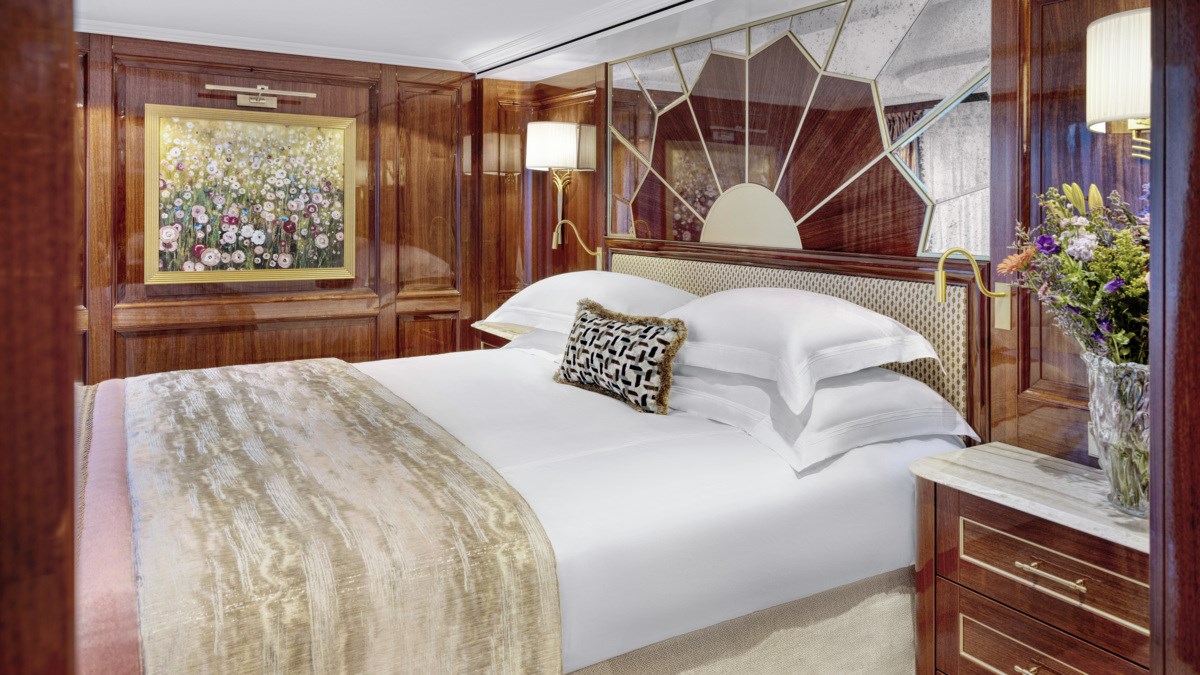
The interior of the S.S. Emilie is primarily crafted from stunning high-gloss walnut veneer, accented with solid decorative frames and exquisite details. Additional materials include marble floors and tabletops, oak herringbone parquet, glass mosaic walls, beveled mirrors with sandblasted decorations, plush custom-made carpets, silk curtains, stained glass doors, and luxurious upholstery in mohair and velvet. As a cherry on top, the artworks in the public spaces are specially created for this project by talented artists.
How and where has the inspiration of Gustav Klimt been integrated into the design?
Gustav Klimt, arguably the most prominent figure of the Vienna Secession art movement, has been a major inspiration for the interior design of the S.S. Emilie. Not only are reproductions of Klimt’s work integrated into the suites and staterooms, but the corridor carpet also features a pattern inspired by his art. Furthermore, the corridors are embellished with drawings and illustrations which come from the period of the Vienna Secession, Jugendstil, and Art Nouveau.
Why does Klimt’s work make for compelling interiors?
Klimt's work appeals to a great audience due to its richness in color and fantasy. His models, which are often portrayed as powerful women and goddesses in fairytale-like settings, embody strength and allure. The vibrant colors and mosaic-like patterns provide a rich source inspiration and themes that are used throughout the interior design.
However, rather than focusing solely on Gustav Klimt, I want to shine light on Klimt’s muse, Emilie Flöge, after whom the ship is named. Emilie was a successful fashion designer and businesswoman—a remarkably emancipated woman at that time! She designed custom-made garments in the style of the Wiener Werkstätte, most notably dresses with high bodices, loose silhouettes, and fluttering sleeves in modern patterns. Emilie liberated women from their tight corsets, giving them greater freedom of movement and ultimately contributing to their health! Klimt's models, as well as Klimt himself, often wore kaftans made by Emilie. Her influence should therefore not be overlooked.
What elements of this design do you hope guests will notice and love as much as you do?
The interior design is inspired by the Vienna Secession, the art movement between 1890 and 1914 that was known for its optimistic worldview and faith in the future. This is reflected in the art by implementing novel techniques, such as the large glass surfaces used in architecture. The style is elegant and organic, characterized by intricate ornamentation and an aversion to symmetry. Common motifs include gracefully stylized plants and flowers—like lilies, irises, poppies, and rosebuds—alongside swans, peacocks, dragonflies, and often delicate female figures.
Each space in the ship has its own unique decorative elements. All suites and staterooms feature bathrooms with glass mosaic walls and beautifully decorated mirrors. The restaurant is decorated with elegant stained-glass doors and a richly upholstered Jugendstil ceiling. Walnut Art Nouveau desks and a crystal palm-leaf chandelier define the lobby, with a prominent portrait of Emilie adding the final touch.
Every area is exceptional, making it impossible for me to pick a favorite. I hope that all guests feel the same way and enjoy an unforgettable holiday aboard the S.S. Emilie!
What were the challenges you met in bringing your designs to life?
Every project has the challenge of completing everything within budget and time. In terms of design, I am given free rein and am wonderfully supported by Uniworld, allowing me to fully bring the fantastic Art Nouveau style to life.
What painter/artist would you love to bring to life for Uniworld next?
I am still keeping that as a surprise. However, you can certainly expect more remarkable women, not only because ships are traditionally given feminine names for good luck, like an overlooking mother or goddess, but also as a way of recognizing influential women of both past and present. I would love to honor more scientists and artists, especially those that have remained somewhat under the radar, just as this ship honors Emilie.
Note: The contents of this article are accurate as of the publication date. Uniworld itineraries and inclusions are subject to change at any time.