Timeless Wonders of Vietnam, Cambodia & the Mekong
15 Days | Ho Chi Minh City to Hanoi
2027 | A fascinating, rewarding, and multilayered adventure.
Learn More
Choose when you want to travel
For 12 adventure-filled days, experience Egypt and the Nile’s most wondrous sites in style and luxury.* Wander amongst the towering ruins of the Temple of Karnak, the world’s largest ancient religious complex, and the entrancing Temple of Luxor. Follow in the footsteps of renowned scholars and explorers as you venture forth into the Valley of the Kings, the ancient burial grounds of Egyptian royalty.
This captivating itinerary begins and ends in Cairo, gateway to Giza. Here, you’ll visit the mighty ancient pyramids, gaze upon the Great Sphinx, and enter the largest archeological museum in the world, the Grand Egyptian Museum.
Generations Family Program (select River Tosca sailings): These cruise/tours feature unique, fun-filled adventures for youngsters and are packed with culturally and historically significant experiences. There will also be an opportunity to meet local children—if your family would like to bring a gift to share with the children (such as school supplies, books, balls or games) it is welcomed.
We facilitate donations on this itinerary to give guests like you the opportunity to gift local communities with much-needed supplies. Visit our Donations page to learn how you can participate.
This program is an active one, including plenty of walking and early starts on most days to take advantage of the favorable morning weather. Flights between Cairo and Luxor may require wake-up calls at 5:00am or earlier. Please contact your travel advisor or Uniworld Reservations for additional details.
*Note: Due to cultural differences and other factors, the beverage policy for our Egypt program differs from our European programs. Please refer to the “What’s Included” section at the bottom of this page for inclusions details.

This day-to-day schedule is subject to change. Your official Schedule at a Glance will be delivered with your cruise e-documents 21-30 days prior to embarkation.
Select Cruise Direction
The embarkation location changes by cruise date. Please refer to the Dates & Pricing tab or your cruise ticket for specific departure details.
Optional, Jordan Pre-Cruise Extension
Day 1
Cairo
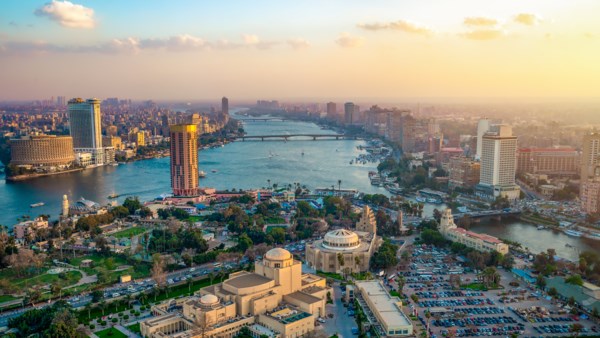
Arrive at Cairo International Airport. If you have arranged a Uniworld arrival transfer, a Uniworld representative will be on hand to greet you and escort you to the opulent Four Seasons Hotel Cairo at Nile Plaza or to the stunning Nile Ritz-Carlton (or similar).
Day 2
Cairo
The ancient quarter of Cairo is intense—the colors, the sounds, the density of people—and it’s likely been this way for thousands of years. Your local expert will show you a 12th-century citadel, the beautiful Alabaster Mosque, and the Grand Egyptian Museum.
Your tour of this historic city includes a visit to the Citadel of Salah al-Din, a massive compound...
Read More
Your tour of this historic city includes a visit to the Citadel of Salah al-Din, a massive compound containing mosques and museums and offering breathtaking views of Cairo. Founded in the seventh century by Arab conquerors, the Fatimid dynasty rulers made Cairo their capital and named it al-Qahira (“the Victorious”). The great sultan Salah al-Din built his citadel in the 12th century as a government center and bulwark against invading armies of Crusaders. Located high above the eastern end of Cairo on El-Moqattam Hill, the citadel was the home of Egypt’s rulers for more than 700 years and is one of the oldest attractions in the city.
After the Ottoman ruler Muhammad Ali seized power in the 1800s, he restored the walls of the citadel and built numerous palaces, schools and government buildings inside. His masterpiece was the great Alabaster Mosque, also known as the Mosque of Muhammad Ali, which you’ll have an opportunity to visit. Its two slender minarets were Muhammad Ali’s declaration of independence from Istanbul, as Ottoman law decreed that only a sultan could build a mosque with two minarets. The mosque’s expansive Turkish-style interior is lit by a beautiful array of lamps suspended from the intricately decorated ceiling.
Finally, end your day admiring artifacts from across the millennia of Egyptian history during a guided visit to the Grand Egyptian Museum. Also known as the "GEM," this long-awaited cultural institution is the largest archeological museum in the world.
Day 3
Cairo, Fly to Luxor (Embark) Cruising the Nile River, Dendera
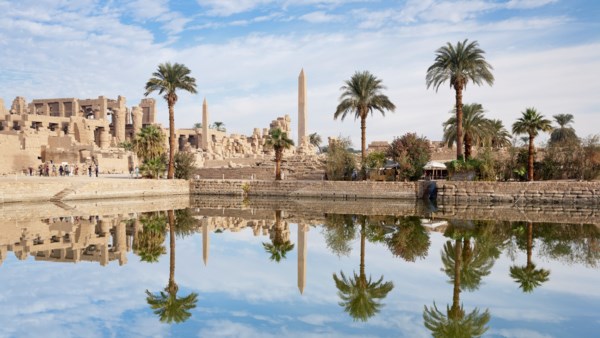
Prepare to be amazed at the legendary Temple of Karnak, a massive and absolutely astounding site, with gigantic columns, broad avenues lined with stone sphinxes and halls of truly epic proportions. This evening, you’ll revel in a Welcome Reception and Dinner onboard.
Note: Flights to Luxor depart early in the morning to take advantage of more favorable weather and traffic conditions, and to optimize tour scheduling.
Before dinner onboard this evening, guests will be treated to a folkloric dance performance. A local band of dancers, in traditional costumes representing different Egyptian districts, will perform a Whirling Dervish show.
After a short flight to Luxor on the east bank of the Nile, you can stroll through the grand avenues of...
Read More
After a short flight to Luxor on the east bank of the Nile, you can stroll through the grand avenues of sphinxes and halls of gigantic columns of the magnificent Temple of Karnak. This vast complex, situated about 2 miles (3.5 kilometers) from the Temple of Luxor, was originally established during the Middle Kingdom (1991-1633 BC), and various dynasties over the next 1,300 years continued to expand it. Karnak is a massive and simply astounding site, reflecting the combined achievements of many generations of ancient builders—as many as 80,000 laborers took part in its creation during the 19th Dynasty alone.
Buried under sand for a thousand years, the UNESCO- designated Karnak complex is composed of three main temples, smaller enclosed temples and several outer temples. The largest of these is dedicated to Amun, a great pharaonic god. Enter the main compound, the Precinct of Amun, through the Great Court, and continue on to the dazzling Great Hypostyle Hall—sometimes called the Hall of Columns—an imposing forest of 134 enormous sandstone columns in the form of papyrus stalks.
Later, you’ll board the magnificent S.S. Sphinx or the elegant River Tosca and set sail for beautiful Dendera. Enjoy a Gala Reception and dinner onboard this evening.
Day 4
Dendera, Cruising the Nile River, Luxor
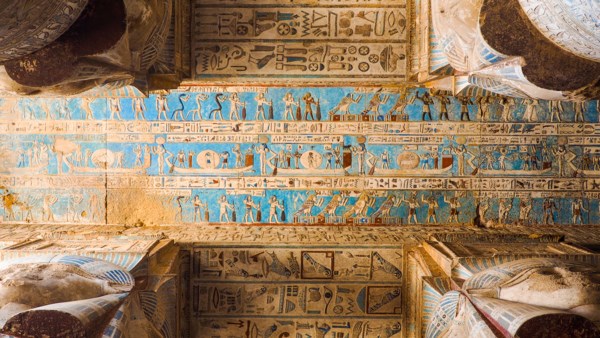
Like its twin shrine, the Temple of Karnak, the Temple of Luxor stands on the site of ancient Thebes, the once flourishing capital of Egypt’s New Kingdom. It was built over hundreds of years and even in ruins it is still an extraordinary place. You’ll also visit the Temple of Hathor, dedicated to the goddess of love and beauty.
The impressive Temple of Hathor at Dendera was dedicated to the goddess of love and beauty. The temple...
Read More
The impressive Temple of Hathor at Dendera was dedicated to the goddess of love and beauty. The temple dates to Egypt’s Ptolemaic era, when the heirs of Alexander the Great ruled over Egypt and adopted Egyptian culture and religion as their own. Built between 125 BC and AD 65, it is one of the best-preserved temples in all of Egypt and features a rare bas-relief of Cleopatra with Caesarion, the son she bore to Julius Caesar.
Return to Luxor for some free time before visiting the ancient Temple of Luxor.
Enter the temple through the great pylon—a ceremonial gateway—where two enormous statues of...
Read More
Enter the temple through the great pylon—a ceremonial gateway—where two enormous statues of Ramses II still stand, along with a pink granite obelisk (its mate stands in the Place de la Concorde in Paris, France). Continue on to an enormous interior courtyard, where the Abu Haggag Mosque once stood atop the ruins of the temple. You can still see a ghostly remnant of the mosque on the east side of the courtyard, high above the columns, its arched doorway opening into thin air.
The temple’s chief architects were Amenhotep III (Egypt’s “Sun King,” also known as Amenophis III) and Ramses II, and it was constructed over hundreds of years, beginning around 1400 BC. It was dedicated to the “father of all life,” the god Amun, sometimes referred to as Amon or Amon-Ra. Ancient Egyptians came to the temple to pay tribute to this god during the Opet Festival, celebrated during the annual flooding of the Nile. Once a year, a great feast was held and the statue of Amun was transported via a small sailboat from the Temple of Karnak to the Temple of Luxor. (Stages of the festival are depicted in friezes along the Temple of Karnak’s grand processional colonnade, the construction of which was started by Amenhotep III and finished by his grandson, Tutankhamen.)
At the rear of the temple is the Sun Court of Amenhotep III, as well as the Bark Shrine that was rebuilt by Alexander the Great (who is depicted bare-chested on the walls). The Luxor Temple complex is at its most stunning at sunset, when it is illuminated with the golden glow of the setting sun.
Day 5
Luxor, Cruising the Nile River, Kom Ombo
The word “colossal” will take on a whole new meaning after today’s excursion to the gigantic twin statues known as the Colossi of Memnon. And that’s just the beginning—you’ll also visit the temple of one of Egypt’s rare female pharaohs as well as the Valley of the Kings, used as a royal burial place for nearly 500 years and where the mummified remains of Tutankhamen are on display.
After dinner onboard tonight, guests will enjoy a Galabeya Party with music, dancing and singing by crew members. Guests are encouraged to bring their own Galabeya clothing.
Get an up-close view of two gigantic statues of Pharaoh Amenhotep III, better known as the Colossi of...
Read More
Get an up-close view of two gigantic statues of Pharaoh Amenhotep III, better known as the Colossi of Memnon. Sixty feet (18 meters) tall and gazing eastward toward the rising sun, the statues depict Amenhotep seated on his throne. Carved next to his legs are his mother and his wife, with side panels depicting the god of the Nile, Hapi. The figures originally sat in front of the mortuary temple of Amenhotep III and are believed to have surpassed even Karnak in size. Unfortunately, the temple itself was slowly dismantled over the centuries to provide building materials for new temples; the twin Colossi continue to stand guard nonetheless, just as they have done for the past 3,400 years.
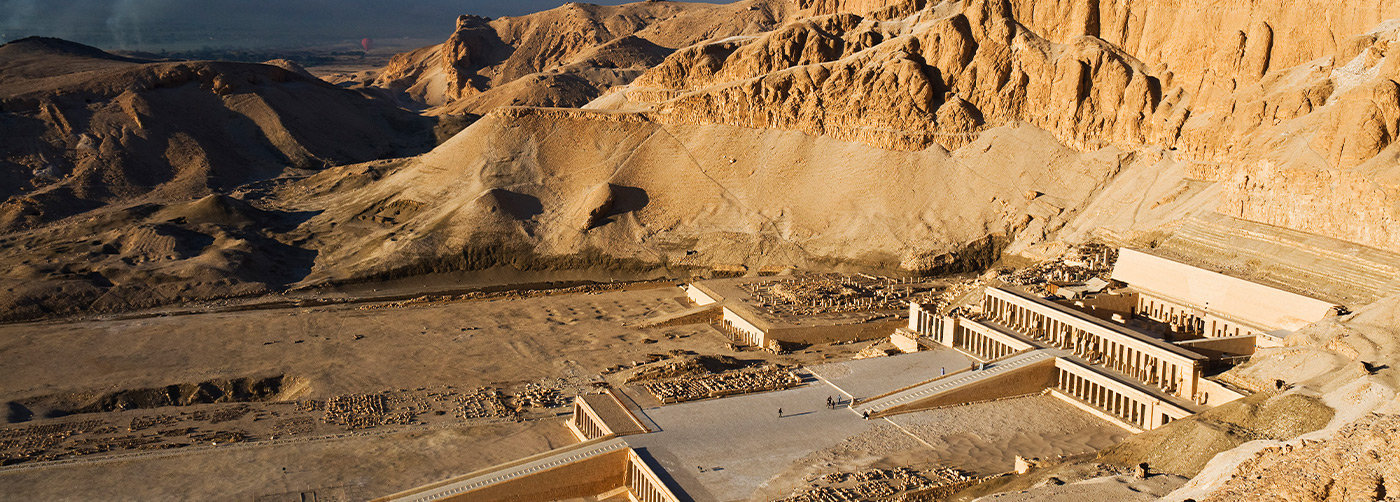
The Temple of Hatshepsut at Deir el-Bahri is another highlight today. One of Egypt’s rare female pharaohs, Hatshepsut is considered by historians to have been one of the most successful rulers of ancient Egypt. Both the setting and the construction of her temple make it unique among the landmarks of Egypt; built into the face of steep cliffs at the basin, the temple is made of limestone instead of sandstone, unlike any other funerary temples of the New Kingdom period. Hatshepsut’s successor, Thutmose III, attempted to remove her name from the temple, and many images of the queen were damaged or destroyed during his reign.
You’ll also visit one of the most famous archeological sites in the world—the remote and barren Valley of the Kings, used for royal burials for nearly 500 years. Much of our understanding of Egyptian mythology has been garnered from these ancient chambers, located about four miles (seven kilometers) inland on the west bank of the Nile. It was here that the bodies of great pharaohs such as Ramses II and Thutmose III were once laid to rest and where the mummified remains of the boy king Tutankhamen are still on display. The idea for establishing this royal burial ground is thought to have originated with Thutmose I, who opted to conceal his tomb far from his mortuary temple in an effort to deter tomb robbers. Subsequent pharaohs did the same, changing a tradition that had endured for close to 2,000 years.
Within the tombs and along the walls of the Valley of the Kings, inscriptions from the Book of the Dead provided instructions on how the pharaohs could safely journey to the next world and avoid the dangers that lay on the way. For the sake of preservation, only a handful of the most interesting tombs are open to visitors at any given time.
Return to the ship and set sail for Kom Ombo. Tonight, don your galabeya (traditional Egyptian attire, samples of which will be available for purchase onboard if you’d like to participate but didn’t bring your own) for a festive onboard party featuring traditional Egyptian music.
Day 6
Kom Ombo, Cruising the Nile River, Aswan
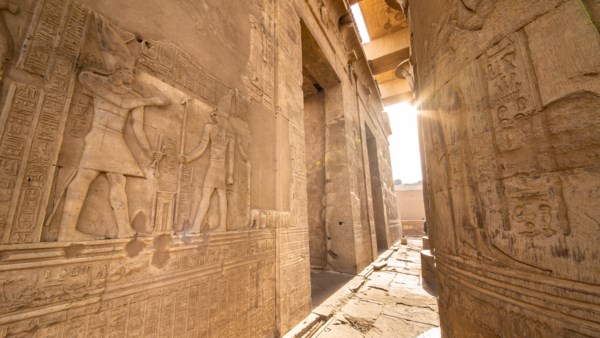
After visiting a temple dedicated to a crocodile god today (don’t miss the display of some of the 300 mummified crocs found in the local area), hop aboard a small boat for a bird-watching excursion along the Nile.
The Kom Ombo Temple, unlike most ancient Egyptian temples, is dedicated to two gods—the crocodile...
Read More
The Kom Ombo Temple, unlike most ancient Egyptian temples, is dedicated to two gods—the crocodile god Sobek and the falcon god Horus the Elder. Construction began under the reign of Ptolemy VI Philometor (180-145 BC) and continued under later rulers, most notably Ptolemy XIII (47-44 BC), who built the inner and outer hypostyle halls. Several of the 300 crocodile mummies discovered in the vicinity are displayed inside the temple.
After a scenic cruise to Aswan, take a small boat along the banks of the Nile on a bird-watching...
Read More
After a scenic cruise to Aswan, take a small boat along the banks of the Nile on a bird-watching excursion. Watch out for colorful native birds, different species of herons, kingfishers, vultures, sunbirds and other wildlife that thrive in the marsh grass along the riverbanks.
Please note: We do not recommend that you pack binoculars in anticipation of this tour, as Egypt prohibits their use and may confiscate them at airport security. We'll be close enough to the wildlife to observe them without the need for additional tools.Day 7
Aswan
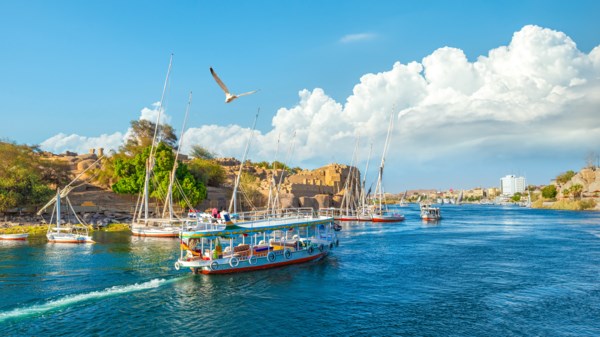
Today is an epic day, filled with wonders from start to finish. You’ll visit a marvel of modern engineering—the Aswan High Dam—as well as the Unfinished Obelisk and the beautiful Philae Temple complex, which was moved from one island to another back in the 1970s. But wait, there’s more. You’ll also take a ride in a felucca—a traditional Egyptian sailboat—and enjoy afternoon tea at a famous hotel depicted in Agatha Christie’s novel Death on the Nile.
The Aswan High Dam, completed in the 1970s, is a marvel of modern engineering that boasts some truly...
Read More
The Aswan High Dam, completed in the 1970s, is a marvel of modern engineering that boasts some truly epic dimensions—it is 11,800 feet (3,597 meters) long; 3,215 feet (980 meters) wide at its base; and 304 feet (93 meters) high—with a reservoir capacity nearly five times that of the Hoover Dam. You’ll also visit the Unfinished Obelisk, commissioned by Queen Hatshepsut yet never completed due to a flaw discovered in the stone. If completed, it would have been the largest and heaviest obelisk ever attempted, weighing more than two million pounds (907,185 kilograms).
Another highlight today is the beautiful Philae Temple complex, originally situated on the island of Philae. It was painstakingly transferred to the island of Agilkia after the construction of the Aswan High Dam to save it from the rising waters of Lake Nasser, a daunting UNESCO-funded endeavor that took 10 years to complete. The three principal monuments on the island all date from the Ptolemaic and Roman periods—the Kiosk of Trajan, the Temple of Hathor and the Temple of Isis.
Note: Guests are welcome to climb around the Unfinished Obelisk, but please note the climb is physically demanding.
Today you will sail serenely down the Nile in a felucca— a small traditional boat with large...
Read More
Today you will sail serenely down the Nile in a felucca— a small traditional boat with large triangular sails—a wonderful way to experience the river as Egyptians have for a thousand years. Later, relax over tea at the historic Old Cataract Hotel Aswan, a colonial-era gem that counts Winston Churchill and Princess Diana among its former guests. This famous hotel was depicted in Agatha Christie’s acclaimed mystery novel Death on the Nile.
Note: Feluccas are wind-powered and thus will operate only if weather conditions permit.
Day 8
Aswan, Cruising the Nile River, Edfu
Spend the day at leisure or join us for an optional excursion to see the magnificent temples of Abu Simbel.
Day 9
Esna, Cruising the Nile River, Luxor
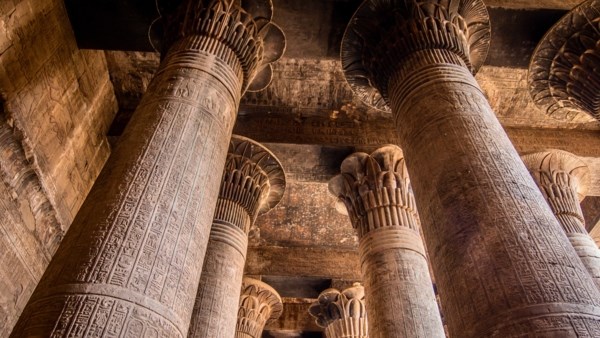
On today’s excursion, you’ll learn how the Temple of Esna was buried under debris for many centuries and is one of the last great Egyptian temples ever built. Your Egyptologist guide will share all sorts of fascinating insights about this significant cultural site and show you the façade bearing the last known hieroglyphic inscriptions ever recorded in Egypt.
The Late Roman Temple of Esna lies on the west bank of the Nile about 34 miles (55 kilometers) south of...
Read More
The Late Roman Temple of Esna lies on the west bank of the Nile about 34 miles (55 kilometers) south of Luxor. Buried under debris for many centuries, the temple is just a short walk from the ship through the local market. It dates from the Ptolemaic and Roman period (180 BC to AD 251) and is one of the last Egyptian temples ever built. Visitors can see two large inscriptions praising Khnum, the ram-headed god of creation, who fashioned mankind on a potter’s wheel from the clay mud of the Nile. There’s also a hypostyle hall with 24 pillars and a ceiling depicting Egyptian astronomical figures and Roman zodiac signs. On the temple’s western wall, look for images of Horus, the god of victory, and Khnum, dragging a net full of fish. At the foot of this façade are the last known hieroglyphic inscriptions ever recorded in Egypt.
Day 10
Luxor (Disembark), Fly to Cairo
Disembark in Luxor and transfer to the airport for your return flight to Cairo. After checking in to your luxury hotel, you’ll have time to relax on your own and explore Cairo at your leisure.
Note: Flights to Cairo depart early in the morning to take advantage of more favorable weather and traffic conditions, and to optimize tour scheduling.
Day 11
Cairo
It’s a day of Bucket List Moments today as we venture to see a number of amazing monuments—including the enigmatic Great Sphinx. You’ll have a thrilling opportunity to view the pyramids from an up-close perspective, the only way to fully appreciate their remarkable size and grandeur.
At the Giza Necropolis, the face of ancient Egypt—the Great Sphinx—awaits your visit....
Read More
At the Giza Necropolis, the face of ancient Egypt—the Great Sphinx—awaits your visit. With the body of a crouching lion and the head of a man, it is the largest monolith statue in the world. Experts believe that the Sphinx (known to the early Arabs as Abu al-Hol, “Father of Terror”) was built in the 26th century BC during Khafre’s reign, perhaps as a portrait of the pharaoh himself. Unfortunately, much of this monument has either eroded or been deliberately destroyed over the years. Some of its facial features are no longer intact, such as the beard and the nose—the latter of which was not shot off by Napoleon’s soldiers, as widely believed, but chiseled away many centuries earlier. A number of excavations in modern times have removed the sand that built up around the Sphinx over the centuries and kept much of it buried. Despite its timeworn condition, the Sphinx still kneels gracefully as it has for thousands of years, looking toward the east with an enigmatic smile.
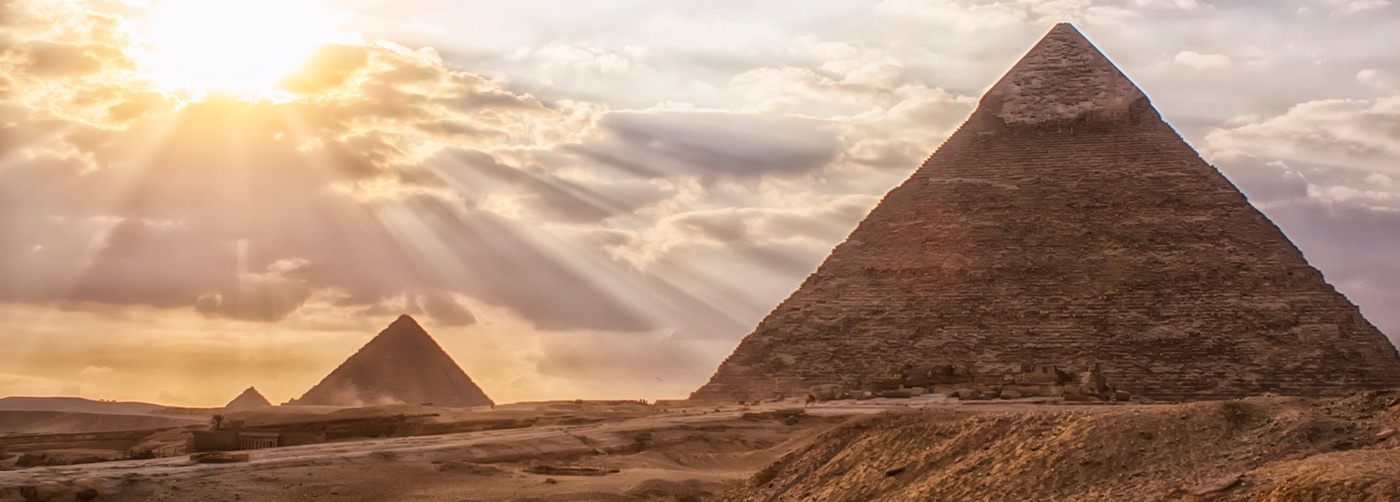
Today you’ll also visit the only surviving Wonder of the Ancient World, the Pyramids of Giza. Beholding these legendary structures up close lets you appreciate their stone masonry and awe-inspiring architectural precision. Until as recently as the 19th century, the oldest and largest of the three pyramids—Khufu—was the tallest building in the world; when it was completed around the 26th century BC, it stood about 50 stories high.
You’ll also see the Step Pyramid of King Zoser (or Djoser) in nearby Sakkara, the oldest pyramid in the world and the prototype for all subsequent pyramids. The ancient architect and sage Imhotep initially designed the pyramid as a single story, then later added five more levels and covered the structure with a shell of fine limestone. In front of the pyramid, Imhotep built a stone structure containing a wooden box with two peepholes; peer inside and you’ll see a life-size painted statue of King Zoser. The peepholes were created to allow the king’s ka (life spirit) to communicate with the outside world.
Day 12
Depart Cairo
Check out of your hotel. If you have arranged a Uniworld departure transfer, you will be transferred to the Cairo International Airport for your flight home. Or, extend your trip with a memorable optional extension in Jerusalem or on the Red Sea.
Optional, The Red Sea Post-Cruise Extension
The Red Sea area is one of the best places in the world for diving, snorkeling and sea sports. Discover why on this post-cruise/tour extension to our Egyptian river cruises, during which you’ll stay at a remarkably elegant resort in Sharm El Sheikh.
Please note: A local host will be with you throughout the itinerary to facilitate flights, excursions, hotel changes and any other needs guests may have.
Optional, Jerusalem Post-Cruise Extension
Optional, Jordan Pre-Cruise Extension
Day 1
Cairo
Arrive at Cairo International Airport. If you have arranged a Uniworld arrival transfer, a Uniworld representative will be on hand to greet you and escort you to the opulent Four Seasons Hotel Cairo at Nile Plaza or to the stunning Nile Ritz-Carlton (or similar).
Day 2
Cairo
The ancient quarter of Cairo is intense—the colors, the sounds, the density of people—and it’s likely been this way for thousands of years. Your local expert will show you a 12th-century citadel, the beautiful Alabaster Mosque, and the Grand Egyptian Museum.
Your tour of this historic city includes a visit to the Citadel of Salah al-Din, a massive compound...
Read More
Your tour of this historic city includes a visit to the Citadel of Salah al-Din, a massive compound containing mosques and museums and offering breathtaking views of Cairo. Founded in the seventh century by Arab conquerors, the Fatimid dynasty rulers made Cairo their capital and named it al-Qahira (“the Victorious”). The great sultan Salah al-Din built his citadel in the 12th century as a government center and bulwark against invading armies of Crusaders. Located high above the eastern end of Cairo on El-Moqattam Hill, the citadel was the home of Egypt’s rulers for more than 700 years and is one of the oldest attractions in the city.
After the Ottoman ruler Muhammad Ali seized power in the 1800s, he restored the walls of the citadel and built numerous palaces, schools and government buildings inside. His masterpiece was the great Alabaster Mosque, also known as the Mosque of Muhammad Ali, which you’ll have an opportunity to visit. Its two slender minarets were Muhammad Ali’s declaration of independence from Istanbul, as Ottoman law decreed that only a sultan could build a mosque with two minarets. The mosque’s expansive Turkish-style interior is lit by a beautiful array of lamps suspended from the intricately decorated ceiling.
Finally, end your day admiring artifacts from across the millennia of Egyptian history during a guided visit to the Grand Egyptian Museum. Also known as the "GEM," this long-awaited cultural institution is the largest archeological museum in the world.
Day 3
Cairo, Fly to Luxor (Embark) Cruising the Nile River, Dendera
Prepare to be amazed at the legendary Temple of Karnak, a massive and absolutely astounding site, with gigantic columns, broad avenues lined with stone sphinxes and halls of truly epic proportions. This evening, you’ll revel in a Welcome Reception and Dinner onboard.
Note: Flights to Luxor depart early in the morning to take advantage of more favorable weather and traffic conditions, and to optimize tour scheduling.
Before dinner onboard this evening, guests will be treated to a folkloric dance performance. A local band of dancers, in traditional costumes representing different Egyptian districts, will perform a Whirling Dervish show.
After a short flight to Luxor on the east bank of the Nile, you can stroll through the grand avenues of...
Read More
After a short flight to Luxor on the east bank of the Nile, you can stroll through the grand avenues of sphinxes and halls of gigantic columns of the magnificent Temple of Karnak. This vast complex, situated about 2 miles (3.5 kilometers) from the Temple of Luxor, was originally established during the Middle Kingdom (1991-1633 BC), and various dynasties over the next 1,300 years continued to expand it. Karnak is a massive and simply astounding site, reflecting the combined achievements of many generations of ancient builders—as many as 80,000 laborers took part in its creation during the 19th Dynasty alone.
Buried under sand for a thousand years, the UNESCO- designated Karnak complex is composed of three main temples, smaller enclosed temples and several outer temples. The largest of these is dedicated to Amun, a great pharaonic god. Enter the main compound, the Precinct of Amun, through the Great Court, and continue on to the dazzling Great Hypostyle Hall—sometimes called the Hall of Columns—an imposing forest of 134 enormous sandstone columns in the form of papyrus stalks.
Later, you’ll board the magnificent S.S. Sphinx or the elegant River Tosca and set sail for beautiful Dendera. Enjoy a Gala Reception and dinner onboard this evening.
Generations
Step off the ship and head to a nearby field to play a sport the whole world has in common: soccer (or...
Read More
Generations
Step off the ship and head to a nearby field to play a sport the whole world has in common: soccer (or football, as it’s known in most countries outside the US). Take this chance to bond with young locals, your fellow passengers and the ship’s crew over a friendly match.
Only available on sailings that belong to the Generations Program.
Day 4
Dendera, Cruising the Nile River, Luxor
Like its twin shrine, the Temple of Karnak, the Temple of Luxor stands on the site of ancient Thebes, the once flourishing capital of Egypt’s New Kingdom. It was built over hundreds of years and even in ruins it is still an extraordinary place. You’ll also visit the Temple of Hathor, dedicated to the goddess of love and beauty.
The impressive Temple of Hathor at Dendera was dedicated to the goddess of love and beauty. The temple...
Read More
The impressive Temple of Hathor at Dendera was dedicated to the goddess of love and beauty. The temple dates to Egypt’s Ptolemaic era, when the heirs of Alexander the Great ruled over Egypt and adopted Egyptian culture and religion as their own. Built between 125 BC and AD 65, it is one of the best-preserved temples in all of Egypt and features a rare bas-relief of Cleopatra with Caesarion, the son she bore to Julius Caesar.
Return to Luxor for some free time before visiting the ancient Temple of Luxor.
Enter the temple through the great pylon—a ceremonial gateway—where two enormous statues of...
Read More
Enter the temple through the great pylon—a ceremonial gateway—where two enormous statues of Ramses II still stand, along with a pink granite obelisk (its mate stands in the Place de la Concorde in Paris, France). Continue on to an enormous interior courtyard, where the Abu Haggag Mosque once stood atop the ruins of the temple. You can still see a ghostly remnant of the mosque on the east side of the courtyard, high above the columns, its arched doorway opening into thin air.
The temple’s chief architects were Amenhotep III (Egypt’s “Sun King,” also known as Amenophis III) and Ramses II, and it was constructed over hundreds of years, beginning around 1400 BC. It was dedicated to the “father of all life,” the god Amun, sometimes referred to as Amon or Amon-Ra. Ancient Egyptians came to the temple to pay tribute to this god during the Opet Festival, celebrated during the annual flooding of the Nile. Once a year, a great feast was held and the statue of Amun was transported via a small sailboat from the Temple of Karnak to the Temple of Luxor. (Stages of the festival are depicted in friezes along the Temple of Karnak’s grand processional colonnade, the construction of which was started by Amenhotep III and finished by his grandson, Tutankhamen.)
At the rear of the temple is the Sun Court of Amenhotep III, as well as the Bark Shrine that was rebuilt by Alexander the Great (who is depicted bare-chested on the walls). The Luxor Temple complex is at its most stunning at sunset, when it is illuminated with the golden glow of the setting sun.
Day 5
Luxor, Cruising the Nile River, Kom Ombo
The word “colossal” will take on a whole new meaning after today’s excursion to the gigantic twin statues known as the Colossi of Memnon. And that’s just the beginning—you’ll also visit the temple of one of Egypt’s rare female pharaohs as well as the Valley of the Kings, used as a royal burial place for nearly 500 years and where the mummified remains of Tutankhamen are on display.
After dinner onboard tonight, guests will enjoy a Galabeya Party with music, dancing and singing by crew members. Guests are encouraged to bring their own Galabeya clothing.
Get an up-close view of two gigantic statues of Pharaoh Amenhotep III, better known as the Colossi of...
Read More
Get an up-close view of two gigantic statues of Pharaoh Amenhotep III, better known as the Colossi of Memnon. Sixty feet (18 meters) tall and gazing eastward toward the rising sun, the statues depict Amenhotep seated on his throne. Carved next to his legs are his mother and his wife, with side panels depicting the god of the Nile, Hapi. The figures originally sat in front of the mortuary temple of Amenhotep III and are believed to have surpassed even Karnak in size. Unfortunately, the temple itself was slowly dismantled over the centuries to provide building materials for new temples; the twin Colossi continue to stand guard nonetheless, just as they have done for the past 3,400 years.
The Temple of Hatshepsut at Deir el-Bahri is another highlight today. One of Egypt’s rare female pharaohs, Hatshepsut is considered by historians to have been one of the most successful rulers of ancient Egypt. Both the setting and the construction of her temple make it unique among the landmarks of Egypt; built into the face of steep cliffs at the basin, the temple is made of limestone instead of sandstone, unlike any other funerary temples of the New Kingdom period. Hatshepsut’s successor, Thutmose III, attempted to remove her name from the temple, and many images of the queen were damaged or destroyed during his reign.
You’ll also visit one of the most famous archeological sites in the world—the remote and barren Valley of the Kings, used for royal burials for nearly 500 years. Much of our understanding of Egyptian mythology has been garnered from these ancient chambers, located about four miles (seven kilometers) inland on the west bank of the Nile. It was here that the bodies of great pharaohs such as Ramses II and Thutmose III were once laid to rest and where the mummified remains of the boy king Tutankhamen are still on display. The idea for establishing this royal burial ground is thought to have originated with Thutmose I, who opted to conceal his tomb far from his mortuary temple in an effort to deter tomb robbers. Subsequent pharaohs did the same, changing a tradition that had endured for close to 2,000 years.
Within the tombs and along the walls of the Valley of the Kings, inscriptions from the Book of the Dead provided instructions on how the pharaohs could safely journey to the next world and avoid the dangers that lay on the way. For the sake of preservation, only a handful of the most interesting tombs are open to visitors at any given time.
Return to the ship and set sail for Kom Ombo. Tonight, don your galabeya (traditional Egyptian attire, samples of which will be available for purchase onboard if you’d like to participate but didn’t bring your own) for a festive onboard party featuring traditional Egyptian music.
Generations
The west bank of Luxor is known far and wide as a great outdoor museum, attracting visitors from all...
Read More
Generations
The west bank of Luxor is known far and wide as a great outdoor museum, attracting visitors from all over the world. What fewer people see, however, are the hidden gems tucked away nearby—the villages that locals call their homes. Explore one for yourself today, and even meet some of the village’s children.
Note, if you’ve brought gifts for local children, now is your opportunity to share them!
Only available on sailings that belong to the Generations Program.
Day 6
Kom Ombo, Cruising the Nile River, Aswan
After visiting a temple dedicated to a crocodile god today (don’t miss the display of some of the 300 mummified crocs found in the local area), hop aboard a small boat for a bird-watching excursion along the Nile.
The Kom Ombo Temple, unlike most ancient Egyptian temples, is dedicated to two gods—the crocodile...
Read More
The Kom Ombo Temple, unlike most ancient Egyptian temples, is dedicated to two gods—the crocodile god Sobek and the falcon god Horus the Elder. Construction began under the reign of Ptolemy VI Philometor (180-145 BC) and continued under later rulers, most notably Ptolemy XIII (47-44 BC), who built the inner and outer hypostyle halls. Several of the 300 crocodile mummies discovered in the vicinity are displayed inside the temple.
After a scenic cruise to Aswan, take a small boat along the banks of the Nile on a bird-watching...
Read More
After a scenic cruise to Aswan, take a small boat along the banks of the Nile on a bird-watching excursion. Watch out for colorful native birds, different species of herons, kingfishers, vultures, sunbirds and other wildlife that thrive in the marsh grass along the riverbanks.
Please note: We do not recommend that you pack binoculars in anticipation of this tour, as Egypt prohibits their use and may confiscate them at airport security. We'll be close enough to the wildlife to observe them without the need for additional tools.Day 7
Aswan
Today is an epic day, filled with wonders from start to finish. You’ll visit a marvel of modern engineering—the Aswan High Dam—as well as the Unfinished Obelisk and the beautiful Philae Temple complex, which was moved from one island to another back in the 1970s. But wait, there’s more. You’ll also take a ride in a felucca—a traditional Egyptian sailboat—and enjoy afternoon tea at a famous hotel depicted in Agatha Christie’s novel Death on the Nile.
The Aswan High Dam, completed in the 1970s, is a marvel of modern engineering that boasts some truly...
Read More
The Aswan High Dam, completed in the 1970s, is a marvel of modern engineering that boasts some truly epic dimensions—it is 11,800 feet (3,597 meters) long; 3,215 feet (980 meters) wide at its base; and 304 feet (93 meters) high—with a reservoir capacity nearly five times that of the Hoover Dam. You’ll also visit the Unfinished Obelisk, commissioned by Queen Hatshepsut yet never completed due to a flaw discovered in the stone. If completed, it would have been the largest and heaviest obelisk ever attempted, weighing more than two million pounds (907,185 kilograms).
Another highlight today is the beautiful Philae Temple complex, originally situated on the island of Philae. It was painstakingly transferred to the island of Agilkia after the construction of the Aswan High Dam to save it from the rising waters of Lake Nasser, a daunting UNESCO-funded endeavor that took 10 years to complete. The three principal monuments on the island all date from the Ptolemaic and Roman periods—the Kiosk of Trajan, the Temple of Hathor and the Temple of Isis.
Note: Guests are welcome to climb around the Unfinished Obelisk, but please note the climb is physically demanding.
Today you will sail serenely down the Nile in a felucca— a small traditional boat with large...
Read More
Today you will sail serenely down the Nile in a felucca— a small traditional boat with large triangular sails—a wonderful way to experience the river as Egyptians have for a thousand years. Later, relax over tea at the historic Old Cataract Hotel Aswan, a colonial-era gem that counts Winston Churchill and Princess Diana among its former guests. This famous hotel was depicted in Agatha Christie’s acclaimed mystery novel Death on the Nile.
Note: Feluccas are wind-powered and thus will operate only if weather conditions permit.
Generations
Get ready for an afternoon of active exploration, starting with a trip down the Nile on a motor boat....
Read More
Generations
Get ready for an afternoon of active exploration, starting with a trip down the Nile on a motor boat. Your Nubian guide will point out local bird and animal species as you go. Arrive at some sand dunes to try your hand at sandboarding, then cool off with a swim in the river.
Only available on sailings that belong to the Generations Program.
Day 8
Aswan, Cruising the Nile River, Edfu
Spend the day at leisure or join us for an optional excursion to see the magnificent temples of Abu Simbel.
Generations
Join your fellow guests and the crew in the lounge for a game party—if you’re lucky, you...
Read More
Generations
Join your fellow guests and the crew in the lounge for a game party—if you’re lucky, you might just win a prize!
Only available on sailings that belong to the Generations Program.
Day 9
Esna, Cruising the Nile River, Luxor
On today’s excursion, you’ll learn how the Temple of Esna was buried under debris for many centuries and is one of the last great Egyptian temples ever built. Your Egyptologist guide will share all sorts of fascinating insights about this significant cultural site and show you the façade bearing the last known hieroglyphic inscriptions ever recorded in Egypt.
The Late Roman Temple of Esna lies on the west bank of the Nile about 34 miles (55 kilometers) south of...
Read More
The Late Roman Temple of Esna lies on the west bank of the Nile about 34 miles (55 kilometers) south of Luxor. Buried under debris for many centuries, the temple is just a short walk from the ship through the local market. It dates from the Ptolemaic and Roman period (180 BC to AD 251) and is one of the last Egyptian temples ever built. Visitors can see two large inscriptions praising Khnum, the ram-headed god of creation, who fashioned mankind on a potter’s wheel from the clay mud of the Nile. There’s also a hypostyle hall with 24 pillars and a ceiling depicting Egyptian astronomical figures and Roman zodiac signs. On the temple’s western wall, look for images of Horus, the god of victory, and Khnum, dragging a net full of fish. At the foot of this façade are the last known hieroglyphic inscriptions ever recorded in Egypt.
Generations
Meet the ship’s captain in the wheelhouse to see how he sails the boat and listen to the story...
Read More
Generations
Meet the ship’s captain in the wheelhouse to see how he sails the boat and listen to the story behind his career.
Only available on sailings that belong to the Generations Program.
Generations
Pedal the banks of the Nile in Luxor for an invigorating outdoor activity in a wonderfully memorable...
Read More
Generations
Pedal the banks of the Nile in Luxor for an invigorating outdoor activity in a wonderfully memorable setting,
Only available on sailings that belong to the Generations Program.
Day 10
Luxor (Disembark), Fly to Cairo
Disembark in Luxor and transfer to the airport for your return flight to Cairo. After checking in to your luxury hotel, you’ll have time to relax on your own and explore Cairo at your leisure.
Note: Flights to Cairo depart early in the morning to take advantage of more favorable weather and traffic conditions, and to optimize tour scheduling.
Day 11
Cairo
It’s a day of Bucket List Moments today as we venture to see a number of amazing monuments—including the enigmatic Great Sphinx. You’ll have a thrilling opportunity to view the pyramids from an up-close perspective, the only way to fully appreciate their remarkable size and grandeur.
At the Giza Necropolis, the face of ancient Egypt—the Great Sphinx—awaits your visit....
Read More
At the Giza Necropolis, the face of ancient Egypt—the Great Sphinx—awaits your visit. With the body of a crouching lion and the head of a man, it is the largest monolith statue in the world. Experts believe that the Sphinx (known to the early Arabs as Abu al-Hol, “Father of Terror”) was built in the 26th century BC during Khafre’s reign, perhaps as a portrait of the pharaoh himself. Unfortunately, much of this monument has either eroded or been deliberately destroyed over the years. Some of its facial features are no longer intact, such as the beard and the nose—the latter of which was not shot off by Napoleon’s soldiers, as widely believed, but chiseled away many centuries earlier. A number of excavations in modern times have removed the sand that built up around the Sphinx over the centuries and kept much of it buried. Despite its timeworn condition, the Sphinx still kneels gracefully as it has for thousands of years, looking toward the east with an enigmatic smile.
Today you’ll also visit the only surviving Wonder of the Ancient World, the Pyramids of Giza. Beholding these legendary structures up close lets you appreciate their stone masonry and awe-inspiring architectural precision. Until as recently as the 19th century, the oldest and largest of the three pyramids—Khufu—was the tallest building in the world; when it was completed around the 26th century BC, it stood about 50 stories high.
You’ll also see the Step Pyramid of King Zoser (or Djoser) in nearby Sakkara, the oldest pyramid in the world and the prototype for all subsequent pyramids. The ancient architect and sage Imhotep initially designed the pyramid as a single story, then later added five more levels and covered the structure with a shell of fine limestone. In front of the pyramid, Imhotep built a stone structure containing a wooden box with two peepholes; peer inside and you’ll see a life-size painted statue of King Zoser. The peepholes were created to allow the king’s ka (life spirit) to communicate with the outside world.
Generations
Head to Sakkara, a village near the pyramids at Giza, to spend a couple hours soaking up the sun at a...
Read More
Generations
Head to Sakkara, a village near the pyramids at Giza, to spend a couple hours soaking up the sun at a local country club. You’ll play a game of soccer with your fellow guests, take a dip in the pool and rest for lunch at the club before heading back to the hotel.
Only available on sailings that belong to the Generations Program.
Day 12
Depart Cairo
Check out of your hotel. If you have arranged a Uniworld departure transfer, you will be transferred to the Cairo International Airport for your flight home. Or, extend your trip with a memorable optional extension in Jerusalem or on the Red Sea.
Optional, The Red Sea Post-Cruise Extension
The Red Sea area is one of the best places in the world for diving, snorkeling and sea sports. Discover why on this post-cruise/tour extension to our Egyptian river cruises, during which you’ll stay at a remarkably elegant resort in Sharm El Sheikh.
Please note: A local host will be with you throughout the itinerary to facilitate flights, excursions, hotel changes and any other needs guests may have.
Optional, Jerusalem Post-Cruise Extension
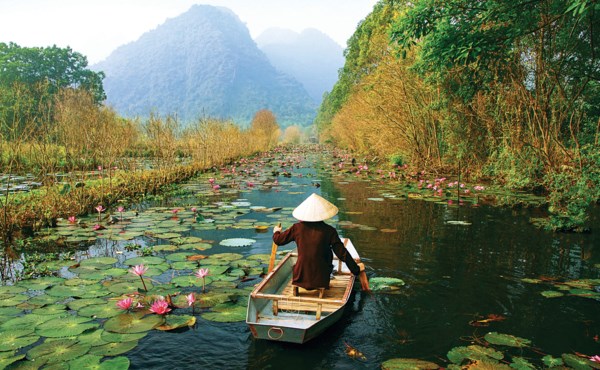
2027 | A fascinating, rewarding, and multilayered adventure.
Learn More
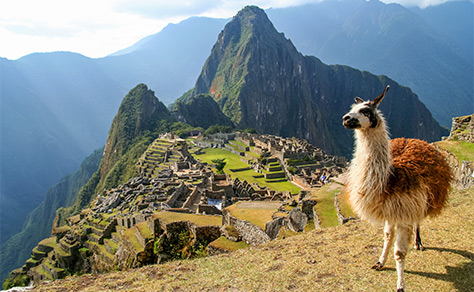
2027 | Experience the very best of Peru over 16 days of wonder and amazement.
Learn More
2027 | Delve deep into India’s fascinating historical and religious heritage.
Learn More